
(00)Before you decide
Before your teams commit to Obscura, they will want clear answers to these questions.
The answers cover where Obscura runs, what it connects to, how AI works, which modules you need and how a pilot runs. You can use them to give leadership, IT, security, legal and procurement the same starting point.
(01)Eleven common questions
These are the questions we hear most, from what Obscura is to how the first pilot starts.
If you have a requirement that is not covered here, share it with our team and we will assess it against your environment and the scope you have in mind.
(A)What it is
What is Obscura?
Obscura is one application for a document's whole journey, so your team creates, approves, signs and stores each document in one place. Years later, your team can still find that document and understand it.
You can run Obscura on your own servers, in a private cloud or on a closed network, and the capabilities you get depend on the modules you choose.
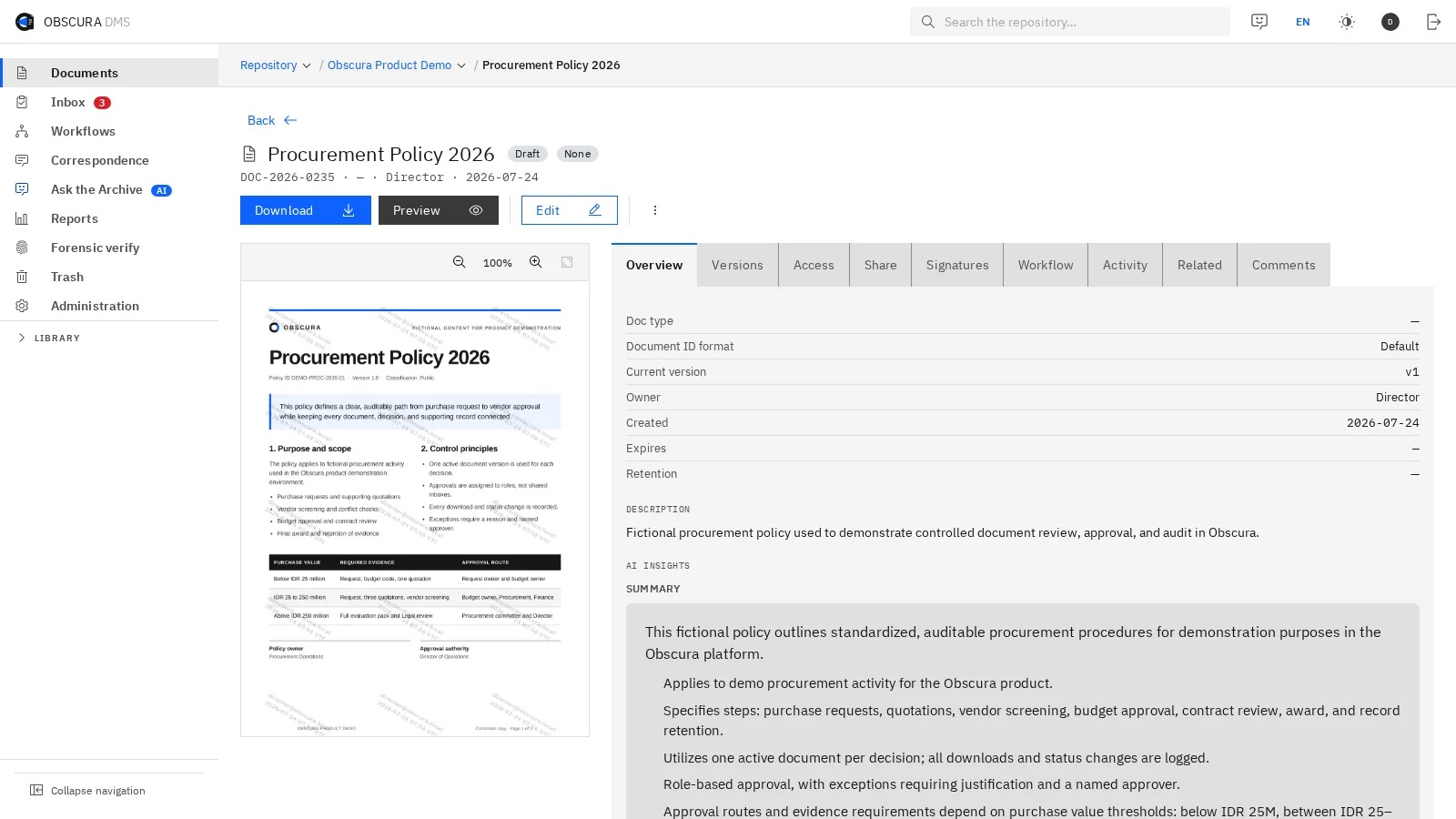 Sample data
(B)Deployment and data
Does Obscura need internet access?
No, the core DMS can run without internet access when its supporting services are available locally.
Obscura only opens an outbound connection for a service that needs one, such as certified signing (PSrE), e‑Meterai, an external AI provider or another system outside your network. Your organisation approves each of those connections before it opens.
What can run on a closed network?
The repository, versions, permissions, full-text search, workflows, retention and the audit history can all run locally. The final list depends on the modules you choose and their supporting services, so we confirm it once we have mapped both.
What infrastructure will we need?
It depends on the number of users, the volume of documents and how quickly it grows, the modules, the integrations and your availability target. After a technical session, our team turns those needs into a server and deployment recommendation.
(C)AI
Does AI require a cloud model?
No, because you can run models on your own infrastructure, connect a provider that you have approved, or keep AI turned off. Document management and full-text search do not depend on AI, so they work either way.
When AI is on, it only uses the documents that the person asking is allowed to see, and every answer links to the sources it came from.
(D)Modules and scope
Can we start with the core DMS?
Yes, you can start with the repository, versions, access control, search and the audit trail, and add other modules when the processes that need them are ready. The modules build on the same foundation, so adding one later does not split your data.
Before you expand, we confirm with you which capabilities are included and which come with optional modules.
How is Obscura put together?
Obscura is built on the core DMS, while capabilities such as correspondence, e‑signature, the Office editor, secure folders and AI are separate modules. You choose the modules that your processes need, so your scope follows the work you actually want to move into Obscura.
(E)Integration and migration
How are certified signing and e-Meterai connected?
Certified signing (PSrE) and e‑Meterai connect through external providers, using connectors set up for the providers you select. Before we switch on a connection, your security team reviews its destination addresses, access rules, credentials and the data it exchanges.
Can Obscura use our existing identity and systems?
Yes, Obscura supports OIDC, LDAP or Active Directory, SCIM provisioning, TOTP for two‑factor sign-in and an OpenAPI‑based API. We confirm your SSO, directory, provisioning and system connections together during discovery, before the pilot starts.
Can we bring the files we already have?
Yes, existing files move in stages from sources such as shared drives, exports from a previous DMS or other systems, email and scanned files. We map them to target folders, document types, metadata, owners and access.
We check a representative sample for OCR, search, previews, metadata and permissions, and we reconcile each batch before the cutover, so your business owners can review the result first.
(F)Demo and pilot
What happens in the demo and the pilot?
We choose one important document and its workflow with you, and we run it in a live demo that shows the capabilities relevant to it. Before a pilot starts, we agree on the users, integrations, scope, success measures and a review point.
(02)Your requirements
Bring one document and the requirements it has to meet, and we will work through them with you.
Tell us about the security controls, integrations or operating constraints that will decide whether Obscura fits your organisation.